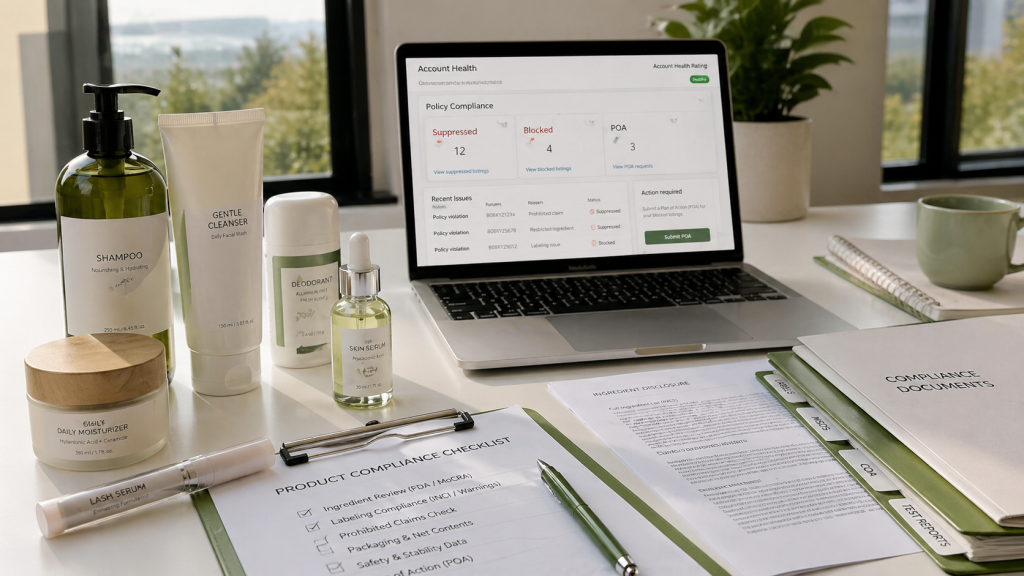


Selling cosmetics on Amazon is not just a catalog task. It is a compliance task.
A moisturizer, serum, shampoo, deodorant, cleanser, or lash product can be removed from search results, suppressed, or fully blocked if Amazon detects a policy risk. For cosmetic brands, the most common triggers are medical claims, restricted ingredients, labeling gaps, unsafe product positioning, or inconsistent documentation.
Amazon states that cosmetics sold in its US store must comply with applicable laws, regulations, and Amazon policies, and must be properly labeled, formulated, and safe for their intended use. The FDA also maintains guidance on prohibited and restricted cosmetic ingredients under US law.
This guide explains why cosmetic listings are blocked, the difference between “Suppressed” and “Blocked,” and how to write a strong Plan of Action, or POA, when Amazon asks for one.
1. Why Amazon Blocks Beauty and Cosmetic Products
Amazon uses automated systems, manual reviews, customer complaints, compliance checks, and policy audits to detect risky listings. In beauty, small wording choices can create a major issue.
Medical claims
A cosmetic product is generally intended to cleanse, beautify, promote attractiveness, or alter appearance. The problem starts when the listing claims the product can treat, cure, prevent, or diagnose a disease or medical condition.
Examples of risky claims include:
“Treats acne.”
“Cures eczema.”
“Repairs psoriasis.”
“Prevents hair loss.”
“Anti-inflammatory treatment.”
“Heals wounds.”
“Antibacterial protection.”
“Clinically proven to eliminate rosacea.”
These phrases can make the product look like a drug, not a cosmetic. That changes the compliance standard. Amazon’s misleading and prohibited claims policy applies to product titles, bullets, images, descriptions, packaging, and marketing materials, and requires claims to be truthful and verifiable.
A safer cosmetic claim is usually focused on appearance, feel, or routine use. For example:
“Helps skin look smoother.”
“Reduces the appearance of blemishes.”
“Leaves hair feeling stronger.”
“Supports a clearer-looking complexion.”
The difference is not cosmetic. It is regulatory.
Prohibited or restricted ingredients
Amazon may also block a product if the formula contains, appears to contain, or is associated with restricted ingredients. This can happen because of the ingredient list, product name, backend keywords, image text, packaging, or customer-facing claims.
Common risk areas include:
Skin lightening ingredients.
Hair growth actives.
Acne treatment ingredients.
Products implying SPF protection without proper sunscreen compliance.
Ingredients restricted under local cosmetic rules.
Prescription-only or drug-like substances.
Contaminants, unsafe color additives, or banned compounds.
The FDA notes that cosmetic companies are responsible for ensuring their products are safe and compliant, and certain ingredients are prohibited or restricted in cosmetics. Amazon may request ingredient lists, certificates of analysis, safety data, test reports, product images, invoices, or proof of regulatory compliance.
Labeling and documentation issues
A listing can also fail when the product detail page does not match the physical product.
Typical examples:
The title says “organic,” but documentation does not support it.
The label shows “anti-acne treatment,” while the listing says “facial cleanser.”
The ingredient list is incomplete.
The product images are blurry or hide mandatory label information.
The brand owner cannot provide invoices from a legitimate manufacturer or supplier.
The product is listed in the wrong category.
Amazon’s restricted products policy states that sellers must comply with applicable laws, regulations, and Amazon policies, and that illegal, unsafe, or restricted products are prohibited.
2. Suppressed vs. Blocked: What Is the Difference?
The terms sound similar, but the business impact is different.
Suppressed listing
A suppressed listing is usually still present in Seller Central, but it is not fully visible or buyable as expected. Amazon may suppress a listing because of missing attributes, poor images, title errors, incomplete product details, prohibited wording, or category compliance flags.
In many cases, suppression is a content or catalog issue.
You may see alerts such as:
“Search suppressed.”
“Fix your products.”
“Listing quality issue.”
“Missing required information.”
“Image does not meet requirements.”
“Product detail page removed from search.”
The listing may be recoverable by correcting the data, removing risky claims, updating images, adding required fields, or submitting missing documents.
Blocked listing
A blocked listing is more serious. Amazon has restricted the sale of the ASIN or SKU because it believes the product may violate policy, law, safety requirements, or category rules.
Blocked listings often appear in Account Health, Policy Compliance, Product Compliance Requests, or Performance Notifications.
Common messages include:
“Listing removed.”
“Restricted product policy violation.”
“Product safety concern.”
“Compliance documentation required.”
“Detail page removed.”
“ASIN blocked.”
“Selling application required.”
A blocked listing usually needs an appeal, supporting evidence, and sometimes a POA. Amazon’s appeal process for listing removals or account deactivation may require sellers to submit a Plan of Action or supporting documents through Account Health.
In simple terms:
Suppressed means Amazon is hiding or limiting the listing until errors are fixed.
Blocked means Amazon has stopped the product from being sold because of a compliance or policy concern.
3. Step-by-Step Guide to Writing a Successful POA
A good POA is not emotional. It is factual, specific, and easy for Amazon to verify.
Amazon expects an appeal to explain the issue, show corrective action, and describe how future violations will be prevented. For restricted product violations, Amazon says sellers may need to provide proof of compliance and a detailed explanation of the issue, corrective steps, and preventive measures.
Step 1: Identify the exact violation
Do not guess. Read the Performance Notification carefully.
Check:
The affected ASINs and SKUs.
The cited policy.
The flagged claim, ingredient, image, or document.
The marketplace involved.
Whether Amazon is asking for documents, edits, or a POA.
Then audit the full product page:
Title.
Bullet points.
Description.
A+ Content.
Images.
Backend keywords.
Brand Store content.
Packaging visible in images.
Customer Q&A if controlled by brand responses.
For cosmetics, also compare the listing with the physical label and formula documentation.
Step 2: State the root cause clearly
Amazon does not want a vague apology. It wants the operational reason the violation happened.
Weak root cause:
“We did not know Amazon rules.”
Strong root cause:
“Our listing used the phrase ‘treats acne’ in bullet point two and on image four. This wording presented the cleanser as a treatment product instead of a cosmetic cleanser. Our internal listing review did not include a regulatory claims check before publication.”
That is specific. It names the claim, the location, and the process failure.
Step 3: Explain immediate corrective actions
List what has already been done.
For example:
Removed all disease, treatment, drug, and medical claims from the title, bullets, images, A+ Content, and backend keywords.
Replaced “treats acne” with “helps reduce the appearance of blemishes.”
Uploaded revised product images showing the current label.
Closed or deleted duplicate SKUs with non-compliant wording.
Reviewed the full ingredient list against applicable cosmetic restrictions.
Attached supplier invoice, ingredient list, Certificate of Analysis, Safety Data Sheet, and product label images.
Paused advertising campaigns using the same non-compliant claim.
Corrective actions must be complete before the appeal is submitted. Do not say “we will fix it.” Say what you fixed.
Step 4: Add preventive measures
This is where many appeals fail. Amazon needs confidence that the issue will not repeat.
Useful preventive measures include:
A cosmetic claims checklist for every new ASIN.
A banned-terms review covering words such as cure, heal, treat, prevent, pain, infection, eczema, psoriasis, acne treatment, antibacterial, antifungal, and SPF unless properly supported.
Regulatory review before listing publication.
Quarterly audits of live ASINs.
Version control for labels, formulas, and listings.
Supplier documentation review before inventory is sent to FBA.
Training for listing, PPC, design, and brand content teams.
A final compliance approval step before any image or A+ Content update goes live.
Preventive actions should be practical. Amazon does not reward long promises. It rewards control.
Step 5: Attach the right documents
For cosmetic brands, useful documents may include:
Product ingredient list.
Product label photos.
Manufacturer invoice.
Certificate of Analysis.
Safety Data Sheet, where applicable.
GMP or ISO documentation, if available.
Lab test reports, if requested.
Formula statement from the manufacturer.
Proof that the product does not contain the flagged ingredient.
Letter of authorization, if brand ownership or distribution is questioned.
Do not overload the case with irrelevant files. Match each document to the violation.
Step 6: Use a clean POA structure
Use this format:
Subject: Appeal for ASIN [ASIN] – Cosmetic Product Compliance
Root Cause
Explain what caused the issue.
Corrective Actions Taken
Explain what has already been fixed.
Preventive Measures
Explain how the issue will be avoided in the future.
Supporting Documents Attached
List each document and what it proves.
Keep it direct. Avoid blaming Amazon, customers, agencies, or suppliers. Own the issue and show control.
FAQ: People Also Ask
Why did Amazon suppress my cosmetic listing?
Amazon may suppress a cosmetic listing because of missing attributes, non-compliant images, incomplete product data, prohibited claims, or category compliance issues. In beauty, medical claims and ingredient concerns are common triggers.
Can I use “acne,” “eczema,” or “psoriasis” in my Amazon listing?
Be careful. These terms can make a cosmetic product appear to treat a medical condition. Unless the product is properly regulated and approved for that use, avoid treatment language. Use appearance-based cosmetic wording instead.
What is the fastest way to fix a blocked beauty listing?
Read the Performance Notification, remove the exact policy issue, collect supporting documents, and submit a concise appeal or POA through Account Health. Do not resubmit the same appeal repeatedly without changes.
Do I need a Plan of Action for every suppressed listing?
No. Many suppressed listings can be fixed by editing content or adding missing information. A POA is usually needed when Amazon asks for an appeal, removes the listing, or cites a compliance violation.
What documents does Amazon request for cosmetics?
Amazon may request product labels, ingredient lists, invoices, lab reports, Certificates of Analysis, safety documentation, or proof that the product complies with applicable laws and policies.
Can Amazon block a listing because of images?
Yes. Claims on images count. If an image says “cures acne” or shows drug-like claims on packaging, Amazon can treat that as a policy issue even if the title and bullets are clean.
Should I create a new ASIN after a cosmetic listing is blocked?
Usually, no. Creating a new ASIN to avoid enforcement can create a bigger Account Health problem. Fix the root issue and appeal the original listing.